Second approach, multiple worlds, unique answer
Based on our findings during our first approach we concluded that we should focus on combinations of announcements and Kripke models where the answer of the riddle is not necessarily a unique world. The way we decided to do this is by imposing a natural order on the worlds, such that when there are multiple worlds that satisfy some announcement $K_BK_A \ldots K_B \psi$, a single unique answer can still be given. For example, by by finding all worlds that satisfy this announcement and picking the world with the highest order. This will allow us to distinguish the orders of Theory of Mind (ToM) regardless as each order should result in a different answer. Although this problem is still not trivial, we were able to construct a Kripke model that satisfies the condition that every layer results in a different answer.
Description of the Kripke model
Consider a Kripke model with 5 states. $S = {w_1, w_2, w_3, w_4, w_5}$. The truth valuation is the following; $\pi’(p) = S \setminus {w_5}$, so $p$ is true in all worlds except world $w_5$. Then there are two types of relations $R$, namely relations for agent $A$, $R_A$ and relations for agent $B$, $R_B$. We have \(R_A = \{(w_1,w_1),(w_2,w_2), (w_3,w_3), (w_4,w_4), (w_5,w_5), (w_2,w_3), (w_3,w_2), (w_4,w_5), (w_5,w_4)\}\), and \(R_B = \{(w_1,w_1),(w_2,w_2), (w_3,w_3), (w_4,w_4), (w_5,w_5), (w_1,w_2), (w_2,w_1), (w_3,w_4), (w_4,w_3)\}\).
The model can also be found in Figure 1.
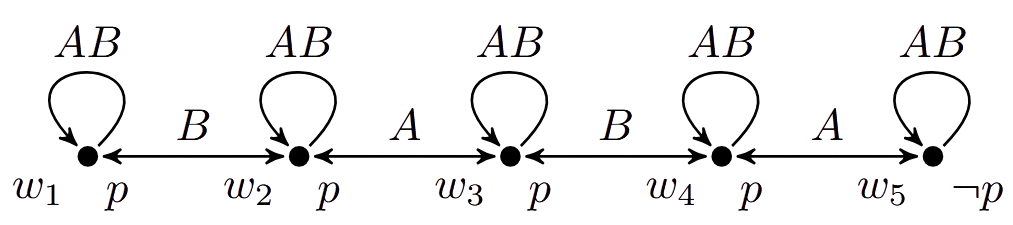
Figure 1: Described Kripke model.
Natural order and announcements
Now we assume the natural order $w_5 \geq w_4 \geq w_3 \geq w_2 \geq w_1$. The answer to the riddle with announcement $\phi$ is then given by the world with the highest order among all worlds that satisfy the announcement $\phi$. If all worlds satisfy the announcement, this would be $w_5$. For the announcements we consider $p$, $K_Ap$, $K_BK_Ap$, $K_AK_BK_Ap$.
Solving for every layer
The problem we now have to solve is the following, for every announcement, which world that satisfies this announcement has the highest order. We will show that every different announcement will result in a different answer.
$p$:
For $p$ this is easy, we have that $p$ is true in all worlds except for world $w_5$. This means that $p$ is true in worlds ${w_1,w_2,w_3,w_4}$. Since for these four worlds $w_4$ has the highest order the answer to this announcement will be world $w_4$
$K_Ap$:
We have that in a certain world $K_Ap$ holds when $p$ holds in all worlds $A$ connected to that given world. Since $p$ does hold in all worlds except for world $w_5$, we have that $K_Ap$ holds in all worlds that do not have an $A$ relation with world $w_5$. This is true for worlds $w_1$, $w_2$ and $w_3$ since worlds are only possibly connected to neighbouring worlds. However, world $w_4$ is $A$ connected with world $w_5$ and therefore $K_Ap$ is not true in world $w_4$. It is also not true in world $w_5$ since this world is $A$ connected with itself. This means that $K_Ap$ is only true in worlds ${w_1, w_2, w_3}$ and the answer to this announcement is $w_3$ since this world has the highest order.
$K_BK_Ap$:
We have that in a certain world $K_BK_Ap$ holds when $K_Ap$ holds in all worlds $B$ connected to that given world. Since $K_Ap$ does hold in all worlds except for world $w_4$ and $w_5$, we have that $K_BK_Ap$ holds in all worlds that do not have a $B$ relation with world $w_4$ or world $w_5$. This is true for worlds $w_1$ and $w_2$ since worlds are only possibly connected to neighbouring worlds. However, world $w_3$ is $B$ connected with world $w_4$ and therefore $K_BK_Ap$ is not true in world $w_3$. It is also not true in worlds $w_4$ and $w_5$ since these worlds are all $B$ connected with themselves. This means that $K_BK_Ap$ is only true in worlds ${w_1, w_2}$ and the only remaining state after this announcement is $w_2$ since this world has the highest order.
$K_AK_BK_Ap$:
We have that in a certain world $K_AK_BK_Ap$ holds when $K_BK_Ap$ holds in all worlds $A$ connected to that given world. Since $K_BK_Ap$ does hold in all worlds except for world $w_3, w_4$ and $w_5$, we have that $K_AK_BK_Ap$ holds in all worlds that do not have an $A$ relation with world $w_3, w_4$ or $w_5$. This is true for world $w_1$ since worlds are only possibly connected to neighbouring worlds. However, world $w_2$ is $A$ connected with world $w_3$ and therefore $K_AK_BK_Ap$ is not true in world $w_2$. It is also not true in worlds $w_3, w_4$ and $w_5$ since these worlds are all $A$ connected with themselves. This means that $K_AK_BK_Ap$ is only true in world ${w_1}$ and the only remaining state after this announcement is $w_1$ since this world has the highest order.
From Kripke model to riddle
It is pretty easy to transform the Kripke model to a riddle once we have found the suitable model. In our case we have chosen a cookies in a jar riddle. Here world $w_i$ corresponds to a jar with $i$ cookies. Here we present the riddle that corresponds with the announcement $K_BK_Ap$. In this riddle, Alex and Bob are perfect logicians who never lie, and this is common knowledge among both.
Given a jar with cookies. Alex and Bob both took one cookie from the jar, which is something they both know, but they don’t know in what order they went for a cookie. After Alex took a cookie from the jar she saw an odd number of cookies. After Bob took a cookie from the jar he saw an even number of cookies. Given that Bob knows that Alex knows that there are less than five cookies in the jar, how many cookies are maximally in the jar?
This riddle can be solved by reasoning in the following way. If Bob knows that Alex knows that there are less than five cookies in the jar, he must know for certain that Alex saw one or three cookies when Alex looked inside the jar. This means that when Bob looked inside the jar there could not have been four cookies since then Alex could potentially have seen five cookies. This means that there could maximally be two cookies in the jar when Bob looked inside the jar and therefore the maximum number of cookies inside the jar is two. Note that this riddle can be extended to any level of ToM that is satisfactory by just increasing the number of cookies.
Consecutive numbers riddle
Quite late into our project, we realised that this riddle is closely related to the consecutive numbers riddle (van Ditmarsch & Kooi, 2015), which goes as follows:
Anne and Bill get to hear the following: “Given are two natural numbers. They are consecutive numbers. I am going to whisper one of these numbers to Anne and the other number to Bill.” This happens. Anne and Bill now have the following conversation.
- Anne: “I don’t know your number.”
- Bill: “I don’t know your number.”
- Anne: “I know your number.”
- Bill: “I know your number.”
First they don’t know the numbers, and then they do. How is that possible? What surely is one of the two numbers?
This riddle and ours have similar Kripke model representations, and the steps to solve both are also quite similar. What sets ours apart is that the setting of our riddle allows it to scale more easily. Adding a higher maximum number of cookies in the jar, would require the solver to make use of more K-operators in their solution, making it possible to test higher orders of ToM. Additionally, since the story around our riddle makes use of tangible objects that could be put out in front of the participants, this riddle might be more suitable for experiments with younger participants, as we believe our riddle to be easier to grasp. This is usually the target group that solves these riddles, as children develop Theory of Mind quite early on.